
 By Marvin
 The productivity losses that show up on balance sheets are easy to see: missed deadlines, failed launches, high turnover. The ones that never show up are harder to measure but often more costly. Your best people, the ones with the skills and the judgment your business depends on, are losing two hours a day to a category of work that generates nothing. They are searching for the document that was shared last Tuesday. They are waiting for the right person to approve a request that arrived three days ago. They are scrolling through message history to find the decision that was made in a thread they were added to late. None of this feels like a problem because it looks like working. But it is not working. It is the tax your organization pays every day for building its operations on tools that were not designed to work together. The fix is not harder work or better habits. It is project management tools that make the right information available in the right place without anyone having to go looking for it.
The notification spiral that steals focused time with Lark Messenger
Most team members have accepted the notification spiral as a normal part of work. A message arrives. They read it. They respond. Three other messages arrive while they were responding. By the time they return to the task they were working on, the concentration they had built up over the previous twenty minutes is gone. What makes this particularly damaging is that the interruptions are not always urgent. The majority are informational updates, casual exchanges, and status messages that could have waited. The cost is paid regardless.
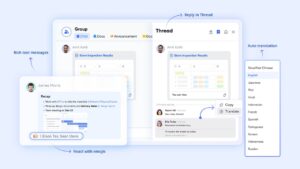
Lark Messenger gives teams the structural tools to separate the urgent from the ambient without requiring anyone to go offline. “Chat Tabs & Threads” keep reference materials and ongoing project discussions organized in named threads so that the main group feed stays clear for messages that actually need attention, and “Real-time Auto Translation” across 24 languages means that international teams are not generating a secondary wave of clarification messages after every cross-language exchange. Lark provides subscription account options that help teams control how information is delivered. Broadcast messages appear directly in the message list and notify team members immediately, while subscription messages are contained within the subscription account and can be reviewed at a later time.
From five draft versions to one live document with Lark Docs
Version chasing is one of the most consistent sources of invisible time loss in professional teams. Someone shares a document for review. Three people make edits in separate copies. Someone else edits the original. By the time the team tries to consolidate, four slightly different versions exist and no one is certain which one captured the most recent decisions. The person responsible for resolving it loses an afternoon they did not budget for, and the final document still carries residual uncertainty about whether everything made it in.
Lark Docs eliminates this category of work by making the multi-version problem structurally impossible. Real-time co-editing by up to 200 simultaneous contributors means there is always exactly one version, and every contributor is working from it simultaneously. “Version History” logs every change with the editor’s name and timestamp, so the evolution of any document is fully traceable without anyone having to maintain a separate change log. When a reviewer leaves feedback, it arrives as a “Comment” thread attached to the specific passage it refers to rather than as a general message that requires the author to locate the relevant section before acting on it. The document workflow that used to cost hours of consolidation time becomes a continuous, self-organizing collaboration.
Live data that ends the status-check cycle with Lark Base
The status check is one of the most quietly expensive habits in operational teams. A manager wants to know where a project stands. They send a message asking for an update. The person they asked has to stop what they are doing, check their own records, compose a response, and return to their original task. Both parties have paid the attention cost of the exchange, and the information that traveled through it could have been visible at any time if the project data lived somewhere both could see. Lark Base makes that visibility the default rather than the exception.
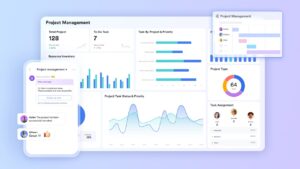
Shared Kanban, Gantt, and gallery views give every stakeholder a live picture of every project’s current state without anyone having to request, compile, or deliver a report. “Personal task views” allow individual contributors to maintain a focused view of their own current work without the noise of other teams’ records competing for their attention. Automated notifications trigger when a record’s status changes, so the person who needs to act next receives a targeted alert at the moment it is relevant rather than discovering the change in a status-check message sent hours later. The manager who used to send three status-check messages per day sends none, because the board already shows the answer.
Cut the scheduling back-and-forth entirely with Lark Calendar
Scheduling a meeting should not require a conversation. Yet in most organizations, arranging a thirty-minute call generates a five-message exchange across two days before a time is confirmed. The invitation still has to be created. The video link still has to be added. The agenda still has to be sent in a separate message. Each of these steps is small, but across a full week of coordination activity for a team of twenty, they amount to a measurable portion of everyone’s working time spent on logistics rather than work.
Lark Calendar removes the scheduling conversation entirely by putting the coordination inside the platform where the need arose. “Schedule in Chat” allows any team member to compare participants’ live availability and confirm a time without leaving the conversation thread, and “Meeting Groups” automatically creates a linked group chat for every event where agendas and pre-reads are shared before the call. Lark supports recurring events and meeting groups that help streamline coordination. When guests are added to “This and following events” or “All events,” they are automatically included in future occurrences and corresponding meeting groups. For single events, however, new participants need to be added manually or join the group themselves.
The knowledge search that should take seconds with Lark Wiki
Every time a team member cannot find a piece of information and sends a message asking for it instead, two people pay the cost of the gap. The person asking loses the time they spent searching before they gave up and asked. The person being asked loses the time they spend answering a question that should have been self-serve. In a team of fifty people, this pattern plays out dozens of times every day, and its cumulative cost is significant even though no single instance seems worth addressing.
Lark Wiki’s “Advanced Search” with powerful filters allows any team member to find any document, policy, or process record in seconds from within the same workspace where they are already working. The sidebar access panel opens the full knowledge base without switching applications, and “Permission Settings” ensure that every team member sees content relevant to their role rather than navigating a disorganized archive of everything the organization has ever documented. “Rich Content” allows Wiki pages to carry embedded spreadsheets, databases, and reference documents alongside text, so the team member who needs full context for a task finds it all in one organized location rather than opening four separate files to assemble the same picture.
Bonus: Why the two hours never show up on a productivity report
The invisible time loss described in this post does not appear in any standard productivity metric because it happens inside what looks like normal working activity. A person chasing a document is working. A person sending a status message is working. A person searching through message history is working. The only way to see the loss is to ask where the time went in a day when nothing unexpected happened, and most organizations never ask that question.
Tools like Slack, Notion, Asana, and Trello each solve one category of this problem without addressing the others. Benchmarking them alongside Google Workspace pricing reveals per-seat costs that appear reasonable in isolation but produce a combined tool stack where each boundary between tools generates its own category of invisible work. Lark removes those boundaries by keeping communication, documents, data, scheduling, and knowledge in the same environment. The two hours do not just shrink. The category that was consuming them disappears.
Conclusion
The two hours your best employees are losing every day are not lost to laziness or distraction. They are lost to the structural friction of a workspace that was assembled from parts rather than designed as a whole. A connected set of productivity tools that makes information visible by default, documents collaborative by design, scheduling frictionless, and knowledge instantly findable gives those two hours back to the people who were paying for them without ever realizing it.