
 By Marvin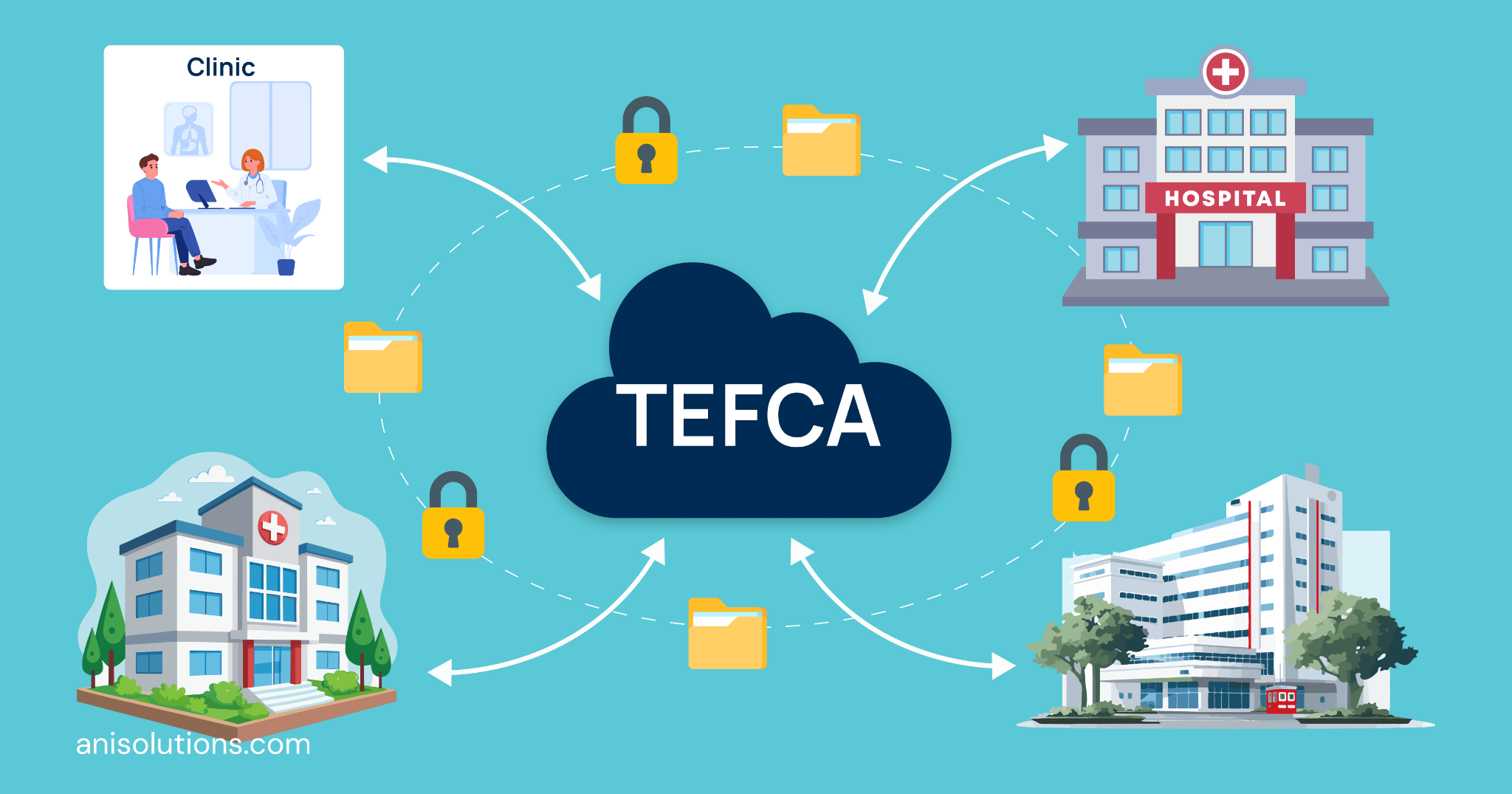
If you are following the healthcare news, especially healthcare interoperability news, then you might have heard about TEFCA. And you might be wondering what exactly TEFCA is and how it will change the healthcare landscape in the future.
Well, to answer your question, TEFCA (Trusted Exchange Framework and Common Agreement) is a new initiative by the Office of the National Coordinator and Health Information Technology (ONC).
The TEFCA healthcare data exchange is going to reshape how you design EHR and connect the healthcare systems significantly. That’s why it is important that you understand some of the lessons that the early adopters shared.
In this blog, we will break down these lessons and how TEFCA works in healthcare, along with the benefits of TEFCA for healthcare.
The QHIN Landscape: Who Are the First Movers?
In the TEFCA healthcare data exchange framework, the foundation is QHINs (Qualified Healthcare Information Networks). These are the data hubs for storing healthcare data for patients.
In simple terms, these can be called a network-of-networks, as all multiple HIEs connect with a single QHIN. However, these QHIN networks were not directly finalized as they progressed over time. The ONC assigned some early networks as testers or first movers; some of those were eHealth Exchange, Epic Nexus, Health Gorialla, Konza, and MedAllies.
These QHINs were the foundation, and by 2025, TEFCA had designated a total of 11 QHINs, including CommonWell Health Alliance, eClinicalWorks, and a few more. Additionally, these QHINs have moved nearly 464 million documents till now, and nearly 71,000 organizations are participating with TEFCA interoperability.
However, compared to the total number, this number is not huge, yet what is important is what these early adopters have learned until now. Let’s take a look at three lessons they have learned with TEFCA.
Operational Hurdles: What Early Adoption Reveals
Early QHIN participants didn’t just flip a switch and start exchanging data. They gathered some insights from the whole process of shifting towards the TEFCA healthcare data exchange. And from those insights, they learned three important things. Let’s take a look at what those are:
- Patient Matching: The first lesson is that connectivity is not the issue with TEFCA governance and QHIN Technical Framework. The real challenge here is to match patient identity because without a national patient ID, the records are matched based on demographic details. This means that if the patient data is incomplete or inaccurate request fails and the unified patient view collapses.
- Onboarding Complexity: While it is beneficial to join a QHIN network, it is not a simple process to do so. Because it means going through legal review, technical build-out, testing cycles, and workflow redesign. Most importantly, you need to have interoperability to share patient data without delays. So, healthcare organizations with custom interfaces or multiple connections face complexities.
- Technical Latency: The technical gap can create gaps in the workflows and integration. For instance, a clinician can access data, but they may not be able to use it immediately, because even if the data is requested and sent to the provider’s EHR, it might not understand it on time. So, this latency and inconsistency present a hurdle for seamless data exchange.
However, these challenges can be solved with proper EHR integration and interoperability. Moreover, as healthcare organizations adopt TEFCA, along with other healthcare data exchange standards, the technical gap will close, and organizations can fully leverage the nationwide data transfer seamlessly.
What It Actually Means for Providers
Let’s be direct about what the clinical upside looks like when TEFCA is implemented well. Most importantly, we need to understand the benefits of TEFCA for healthcare providers, because if it fails to deliver the right benefits, the adoption rate and speed will be slow:
Longitudinal patient records across systems and states: When a patient shows up at your facility having received care elsewhere, TEFCA makes it significantly easier to retrieve relevant history — medications, allergies, prior diagnoses, test results — without waiting for manual records requests.
Fewer duplicate tests: Not knowing what tests a patient already had is one of the most common drivers of redundant testing in healthcare. Access to prior results through TEFCA reduces this directly.
Simpler consent and data governance: Because all TEFCA participants operate under the same legal agreements and technical requirements, the consent and data sharing frameworks are standardized. That reduces administrative overhead for both providers and patients.
Better care coordination: For patients with complex or chronic conditions who see multiple providers, a national-scale data exchange network means care teams can actually work from the same picture.
The Business Case Is Real, But It Takes Preparation
From a strategic standpoint, organizations connecting through a QHIN can consolidate what previously required multiple separate HIE relationships into a single framework — real cost reduction over time. There’s also alignment with CMS reimbursement models and value-based care initiatives. Access to longitudinal patient data is increasingly an operational necessity, not just a clinical preference.
That said, a 2024 industry study found roughly one-third of health information organizations remain uncertain about TEFCA participation, citing upfront costs and unclear short-term ROI. Many providers already exchange data through state HIEs or vendor networks, so TEFCA can feel redundant early on.
The organizations making it work treat TEFCA connectivity as a long-term infrastructure investment — not expecting day-one returns, but building toward a better-connected position as the network scales.
Where TEFCA Is Headed Next
TEFCA is not standing still. The roadmap for 2025 and beyond includes several significant expansions.
The move toward FHIR-based data exchange is accelerating. The QHIN Technical Framework is evolving through a four-stage FHIR roadmap, with QHIN-to-QHIN FHIR exchange (Stage 3) now being piloted. This matters because FHIR-based exchange is faster, more structured, and more interoperable than older document-based query approaches.
Exchange purposes are also expanding beyond treatment. TEFCA now supports payment, healthcare operations, public health, and government benefits determination as recognized exchange purposes. Federal agencies — including the VA, CMS, CDC, and SSA — are actively being onboarded, which significantly increases the reach and value of the network.
And while QHIN participation is currently voluntary, there are early signals that alignment with TEFCA may become increasingly tied to federal program participation and value-based care frameworks over time. Organizations that build toward TEFCA readiness now will be better positioned for whatever comes next.
Conclusion: From Early Adoption to Industry Standard
In a nutshell, TEFCA is the initiative by Federal institutes for creating a nationwide patient data storage and making the patient data easily available to patients and providers. The biggest advantage of this framework is better patient care, as clinicians will have faster access to complete patient records from anywhere in the country.
Moreover, from the insights by the early adopter, it is clear that while there are some challenges and complexity the opportunity is also huge. With proper EHR integration and up-to-date EHR systems, healthcare providers can efficiently participate in the TEFCA healthcare data exchange.
If you are interested in onboarding to TEFCA, then talk to our subject matter experts to know whether your EHR integration is strong enough to seamlessly integrate with QHIN networks.
Frequently Asked Questions
1. What is TEFCA and how does it work in healthcare?
TEFCA — the Trusted Exchange Framework and Common Agreement — is a federal framework led by ONC that establishes the rules and technical standards for how health information networks connect and exchange data across the US. It works through a network of Qualified Health Information Networks (QHINs) that connect to each other and to participating healthcare organizations, enabling nationwide query-based data exchange under a common set of agreements.
2. What are QHINs and why are they important?
QHINs are organizations designated by ONC that have met specific technical and governance requirements to serve as trusted hubs for TEFCA data exchange. They’re important because they form the backbone of the national network — connecting to each other and to participant organizations, so that joining one QHIN gives an organization access to data across the broader ecosystem.
3. How does TEFCA healthcare data exchange improve interoperability?
TEFCA improves interoperability by replacing a patchwork of point-to-point integrations and regional HIEs with a single national framework. Instead of building separate connections to each network or partner, organizations can connect once through a QHIN and exchange data with any other TEFCA participant nationwide — under standardized legal agreements and technical specifications.
4. What are the benefits of TEFCA for healthcare organizations?
TEFCA gives healthcare organizations access to a single national framework that replaces multiple fragmented HIE connections. Providers can retrieve longitudinal patient records across state lines, reduce duplicate testing, cut manual record retrieval costs, and align with CMS value-based care models — all through one standardized network.
5. How will TEFCA evolve in the coming years?
TEFCA is moving toward full FHIR-based exchange between QHINs, expanding use cases beyond treatment into payment, public health, and government benefits. Federal agencies like the VA, CMS, and CDC are being onboarded, and payer-provider connectivity pilots are already underway for 2026 and beyond.
6. What challenges do providers face when joining a QHIN?
The most common challenges are patient matching (identifying the same patient across different systems without a national ID), data quality issues that make records hard to match, and the technical complexity of connecting existing EHR infrastructure to the QHIN’s requirements. Onboarding is effectively a system integration project, not just a sign-up process.
7. Is TEFCA mandatory for all healthcare providers?
As of early 2026, TEFCA participation is voluntary. However, there are growing signals that alignment with TEFCA may become tied to federal program participation and value-based care model requirements over time. Most health IT leaders are treating TEFCA readiness as a strategic priority, even where it isn’t yet required.